
How to Build Operational Excellence Through Data
Operational excellence — the ability to deliver with speed, quality, and efficiency — is no longer about process optimization alone. It’s about how effectively an organization captures, governs, and leverages data. Increasingly, it’s also about how intelligence and automation are infused into daily operations to unlock agility and resilience.
In this post, we’ll explore how organizations can build operational excellence through a data-first approach.
Redefining Operational Excellence in the Age of Data
Traditionally, operational excellence was framed around lean processes, cost control, and continuous improvement frameworks. These remain important, but the definition has expanded.
Today, operational excellence means:
- Running on trusted, real-time data instead of gut instinct
- Embedding data-driven intelligence into decisions and workflows
- Creating a data culture where teams can act on insights, not wait for reports
In short: Data is the foundation. Intelligence is the accelerator.
The Data Journey to Operational Excellence
Here’s the roadmap organizations can follow to build operational maturity:
1. Capture the Right Operational Data
You can’t optimize what you can’t measure. For most organizations, this means integrating:
- ERP and supply chain data
- CRM and customer experience data
- IoT/sensor data from machines, warehouses, or logistics
- Workforce and productivity data
Diverse, high-quality data is the starting point.
2. Elevate Data Governance & Quality
Governance isn’t bureaucracy — it’s the backbone of trustworthy insights.
- Consistent definitions avoid operational confusion
- Privacy and compliance keep regulators confident
- Standardization ensures systems and analytics perform reliably
Without this, analytics and automation become liabilities rather than assets.
3. Integrate and Break Down Silos
Operational data is often scattered across functions. The goal is to connect the dots:
- Data platforms that unify ERP, CRM, and IoT data
- APIs that connect external and partner ecosystems
- Data hubs or meshes that make data accessible across teams
When silos fall, cross-functional intelligence rises.
4. Apply Analytics for Insightful Decisions
Analytics is the bridge between data and action:
- Descriptive analytics → “What happened?”
- Diagnostic analytics → “Why did it happen?”
- Predictive analytics → “What’s likely to happen next?”
- Prescriptive analytics → “What should we do about it?”
Analytics should be seen not just as dashboards, but as a decision engine for the enterprise.
5. Infuse Automation & Intelligence
This is where operational excellence scales:
- Predictive maintenance using IoT data
- Demand forecasting to strengthen supply chain planning
- Automated decisioning in logistics, scheduling, or workforce planning
- Natural language tools that give every employee access to insights
The goal is to embed intelligence into the flow of work, not bolt it on afterward.
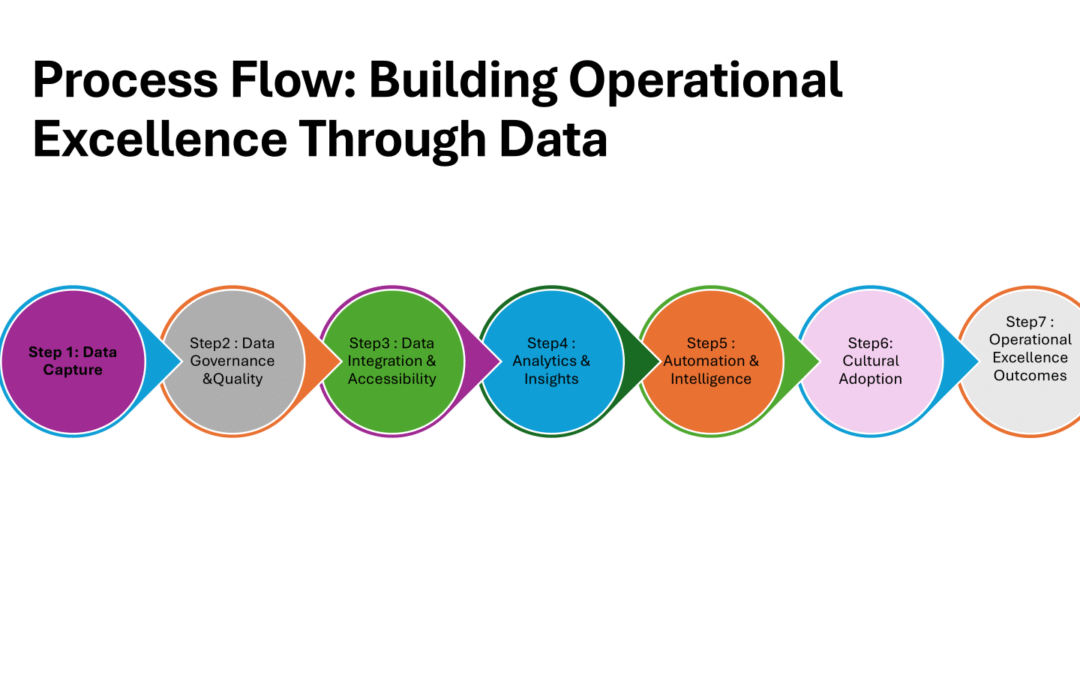
Step 1: Data Capture
- Collect from ERP, CRM, IoT, workforce, external sources
- Ensure completeness and relevance
Step 2: Data Governance & Quality
- Standardize definitions
- Apply compliance & privacy rules
- Cleanse and validate data
Step 3: Data Integration & Accessibility
- Connect siloed systems (ERP, CRM, IoT)
- Use APIs, data hubs, or meshes
- Enable enterprise-wide access
Step 4: Analytics & Insights
- Descriptive (what happened)
- Diagnostic (why it happened)
- Predictive (what will happen)
- Prescriptive (what should we do)
Step 5: Automation & Intelligence
- Predictive maintenance
- Demand forecasting
- Automated decisioning
- Self-service data tools
Step 6: Cultural Adoption
- Data literacy across teams
- Embed insights into workflows
- Encourage trust & usage
Step 7: Operational Excellence Outcomes
- Greater efficiency
- Agility in response
- Improved customer experience
- Resilience & innovation
From Process to Practice
While the process flow lays out the technical journey of capturing, governing, and activating data, true operational excellence depends on how consistently these steps are practiced across the organization. A well-designed data architecture or analytics platform delivers little value if the insights don’t reach the right people, at the right time, in the right context. This is where the transition from systems and processes to people and culture becomes essential. Technology can streamline operations, but only a culture that values data-driven decision making ensures those improvements are sustained and scaled.
Building a Data-First Culture
Technology alone won’t deliver excellence. It’s about people and culture.
- Leaders must champion data literacy at all levels.
- Teams must feel empowered to use data in real-time decisions.
- Success stories should be shared to reinforce a culture of trust in data.
As the saying goes: Data can’t replace judgment, but it can sharpen it.
Benefits of Data-Driven Operational Excellence
Organizations that take this journey see measurable results:
- Efficiency → lower costs, less downtime, optimized resources
- Agility → faster response to disruptions or opportunities
- Customer impact → consistent, high-quality experiences
- Resilience → stronger supply chains and risk management
- Innovation → more time for growth, less on firefighting
Final Thoughts
Operational excellence is no longer achieved with process frameworks alone — it’s achieved with data-first thinking and intelligence-driven execution.
The future belongs to organizations that:
- Govern data as a strategic asset
- Integrate across silos for enterprise-wide visibility
- Use intelligence not as a buzzword, but as a force multiplier for operations