Most AI automation projects fail. Not because the technology doesn’t work. Because companies are automating the wrong thing — and throwing money at it anyway.
The instinct is logical: automate the most painful process. The one keeping everyone up at night. The chaotic one.
Here’s why that blows up: painful processes are usually painful because nobody’s written down how they actually work. You can’t automate what you don’t understand. So you end up automating chaos — which just makes chaos worse, faster.
The processes that actually work aren’t the painful ones. They’re the boring ones. Repetitive. High volume. Clear rules. If you can describe what “correct” looks like, AI crushes it. Humans handle the exceptions.
This is the difference between a project that pays for itself in 6 months and one that costs thousands and sits gathering dust.
Five processes that actually deliver results
1. Document processing — Eliminate hours of manual data entry
Invoices, contracts, applications, compliance forms. AI reads them, pulls the fields instantly, routes them perfectly. Clear inputs. Clear outputs. Real, measurable time savings.
2. Customer enquiry triage — Never lose an urgent email again
Emails arrive. AI figures out what they need instantly, drafts responses for you to check, escalates the critical ones. You stay in control. The chaos disappears.
3. Recurring reports — Free up your best person’s entire Monday
Someone builds the same report every Monday. Same three systems. Same formatting. Every single week. The moment you automate it, that time becomes available. Permanently.
4. Screening and sorting — Make the right call, every time
Which leads actually fit your criteria? Which support tickets are routine? Which applications are complete? AI makes the first call correctly. You make the real decisions.
5. Generating structured content — Scale without hiring more people
Test questions, product descriptions, summaries — anything rule-governed and repetitive. We built Abhivrddhi, an AI-powered exam platform, and learned this the hard way: generating content is easy. Building the workflow so people trust it is where 90% of projects fail. We got it right.
AI automation vs traditional automation — which actually wins?
Traditional automation: if X, then Y. Fast. Predictable. Breaks immediately when reality doesn’t match the rule.
AI automation handles the real world: messy data, five different document formats, emails written in five different ways. It learns patterns instead of blindly following a script.
The catch: if your process is already clean and rule-based, you might not need AI. Conventional automation is cheaper. AI earns its cost — and then some — when the inputs are chaotic or written in natural language.
The five-question test (pass all five, or you’ll fail)
Ask these rigorously:
Does it happen often? (If it’s twice a year, you’ll regret spending time on it.)
Can you write it down? (Step by step. If you can’t describe it, AI can’t learn it — guaranteed.)
Is the input already digital? (Paper-only processes drain budgets without delivering results.)
Can you define what “correct” means? (You need to validate the AI’s work, at least initially. If you can’t, it will fail.)
What happens if it gets it wrong? (If an error costs money or reputation, keep a human in the loop — or don’t automate yet.)
Pass all five? You’re ready to win. Fail on 2 or 5? You will lose money. Wait.
Processes that will sabotage your project (avoid these)
Don’t automate decisions with legal or safety stakes — someone needs to own those consequences, and AI can’t. Don’t automate relationship work — negotiations, difficult feedback, sensitive conversations. These are where customers fire you, not where AI helps. Don’t automate problems you don’t understand — it just accelerates failure.
And the biggest mistake: if your process is broken, automating it doesn’t fix it. It breaks things faster, and you’ll blame the AI.
How to start without crashing your business
Run a shadow pilot: let AI do the work alongside your person for one complete workflow. Compare outputs obsessively. Only switch over when the AI consistently matches or beats the manual version.
A proper pilot takes 4–8 weeks and typically costs £5,000–£20,000 using existing APIs — depending on how many legacy systems you need to connect. Most people expect six figures and panic. It’s not.
The bigger cost? Not the software. It’s workflow redesign and review time — your team rethinking how they work once the boring part is gone.
Start with one process. One team. One outcome you can measure. Prove it works. Then you have the template that scales to everything else.
Questions everyone asks (and the straight answers)
How much does it actually cost?
API-based automation for a single process: £5k–£20k depending on integration complexity. Custom AI models cost way more — but most businesses don’t need them and waste six figures finding that out.
How long until we see results?
4–12 weeks from “let’s explore” to “it’s live”, including a pilot where you test it against the human version in parallel. You’ll know if it works before you commit fully.
What data do I need?
Digital access to the inputs your process uses. A few hundred examples to test against. Perfect data isn’t required — representative data is. People overthink this and delay for nothing.
Is it worth it for a small team?
Often more so. Small teams feel repetitive admin harder. Pick one high-frequency process instead of trying to transform everything at once — and watch one person’s time free up completely.
Ready to stop wasting time on the wrong processes?
We’ve helped organisations identify which processes actually deliver ROI, scope pilots that don’t disrupt operations, and run them in parallel while you validate the results. We’ve also built Abhivrddhi — an AI product live in the education sector with real paying customers — so we know firsthand what succeeds and what fails catastrophically.
If you’d like to talk through which of your processes might be the winner,get in touch. No obligation. Just a conversation about what automation could actually solve for you.
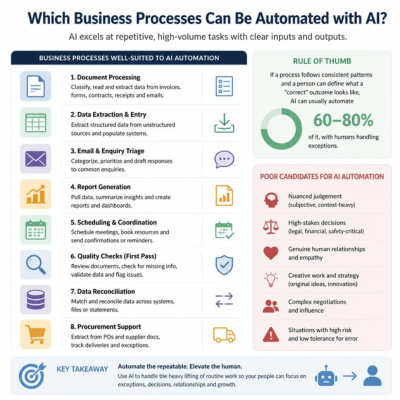
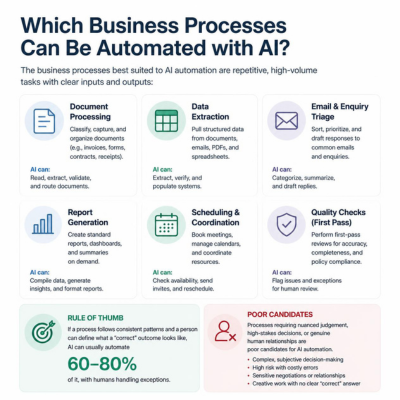
The business processes best suited to AI automation are repetitive, high-volume tasks with clear inputs and outputs: document processing, data extraction, email and enquiry triage, report generation, scheduling, and first-pass quality checks. As a rule of thumb, if a process follows consistent patterns and a person can define what a “correct” outcome looks like, AI can usually automate 60–80% of it, with humans handling exceptions. Processes requiring nuanced judgement, high-stakes decisions, or genuine human relationships are poor candidates.
That’s the short answer. The longer answer — and the one that determines whether your first AI project succeeds — is about how to identify those processes inside your own business. Here is the framework we use at Dee & Lee when we assess automation opportunities with clients.
Which business processes can be automated with AI? The five strongest categories
1. Document-heavy workflows. Invoices, contracts, applications, compliance paperwork. AI can read unstructured documents, extract the relevant fields, and route them — work that traditionally consumed hours of administrative time. This is the most common starting point we see, because the inputs are contained and the outputs are verifiable.
2. Communication triage. Customer enquiries, support tickets, inbound emails. AI can categorise, prioritise, draft responses for review, and escalate what needs a human. The human stays in the loop; the sorting disappears.
3. Data extraction and reporting. Pulling figures from multiple systems, reconciling them, and producing recurring reports. If someone in your business spends every Monday morning assembling the same report, that is an automation candidate.
4. Repetitive decision support. First-pass screening: which leads fit our criteria, which claims look standard, which applications are complete. AI makes the routine call; humans make the judgement call.
5. Content and assessment generation. Producing structured, rule-governed content at scale — product descriptions, test questions, summaries — with human review. We know this category first-hand: our own product, Abhivrddhi, uses AI to generate exam questions and analyse student performance for the education sector. What we learned building it applies broadly — generation is the easy half; the workflow around review and quality control is where the real design work sits.
What is the difference between AI automation and traditional automation?
Traditional automation follows explicit rules: if X, then Y. It works brilliantly for fully structured tasks and breaks the moment reality deviates from the rule. AI automation handles variation — it can read a document it hasn’t seen before, interpret an ambiguously worded email, or classify something based on patterns rather than exact matches.
The practical implication: if your process already runs on clean, structured data and fixed rules, you may not need AI at all — conventional automation is cheaper and more predictable. AI earns its cost where the inputs are messy, varied, or written in natural language.
How do I know if a specific process is a good candidate?
Run each process through five questions:
Is it frequent? Automating something that happens twice a year rarely pays back.
Can you describe it step by step? If your team can’t write the process down, AI can’t learn it reliably.
Are the inputs available digitally? Paper-only processes need digitisation first.
Can you define “correct”? You need a way to check the AI’s output, at least during the early months.
What happens when it’s wrong? If an error is cheap to catch and fix, automate confidently. If an error is costly or irreversible, keep a human in the loop — or don’t automate.
A process that passes all five is a strong candidate. A process that fails question 2 or 5 should wait.
What processes should NOT be automated with AI?
Be equally clear about the exclusions. Poor candidates include: decisions with legal or safety consequences where accountability must sit with a person; relationship-driven work such as negotiations and sensitive customer conversations; genuinely novel problem-solving; and any process your organisation doesn’t yet understand well. Automating a broken process gives you a faster broken process.
There is also a category we’d call “not yet” processes where the data exists but is scattered, inconsistent, or locked in legacy systems. These are future candidates — after a data clean-up, not before.
How do I start with AI automation without disrupting current operations?
Start with a shadow pilot: run the AI alongside the existing manual process for one workflow, compare outputs, and only switch over once the AI consistently matches or beats the human baseline. A well-scoped pilot of this kind typically takes 4–8 weeks and, using existing AI APIs rather than custom models, usually sits in the low five figures rather than the six-figure territory people fear .
For most SMEs, an API-based automation of a single process typically ranges from £4,000–£30,000 depending on integration complexity — far less than custom model development, which most businesses don’t need. (Gartner’s 2025 AI Adoption study suggests SME AI projects average £8,500–£25,000 for scoped pilots.) The bigger ongoing cost is usually workflow redesign and review time, not the AI itself. We’ve found that most clients see payback within 6–12 months on a single high-frequency process.
The sequencing that works: one process, one team, one measurable outcome. Prove it, document it, then expand. Organisation-wide transformation programmes fail far more often than narrow pilots — the evidence from our own client work and from building Abhivrddhi points the same way.
Frequently asked questions
How much does AI process automation cost? For most SMEs, an API-based automation of a single process typically ranges from a few thousand to a few tens of thousands of pounds depending on integration complexity — far less than custom model development, which most businesses don’t need. The bigger ongoing cost is usually workflow redesign and review time, not the AI itself.
For most SMEs, an API-based automation of a single process typically ranges from £4,000–£30,000 depending on integration complexity — far less than custom model development, which most businesses don’t need. [Gartner’s 2025 AI Adoption study suggests SME AI projects average £8,500–£25,000 for scoped pilots.] The bigger ongoing cost is usually workflow redesign and review time, not the AI itself. We’ve found that most clients see payback within 6–12 months on a single high-frequency process.
How long does an AI integration project take? A focused single-process automation typically takes 4–12 weeks from scoping to production, including a pilot phase. Timelines extend mainly when data needs cleaning or multiple legacy systems need connecting.
What data do I need before starting an AI project? You need digital access to the inputs the process uses (documents, emails, records) and enough historical examples to test against — often a few hundred, not millions. Perfect data is not required; representative data is.
Is AI automation worth it for a company with fewer than 50 employees? Yes, often more so than for large firms, because smaller companies feel repetitive admin proportionally harder. The key is choosing one high-frequency process rather than attempting broad transformation.
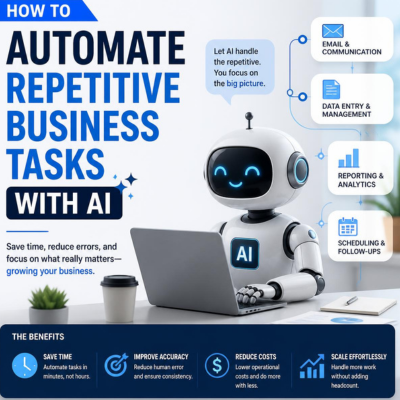
Repetitive business tasks can quietly take up a huge amount of time. AI can help automate many of them so your team can focus on higher-value work.
The goal is not to automate everything. It is to remove the work that happens again and again without adding much strategic value.
For small businesses, that can mean faster communication, simpler admin, better reporting, and fewer missed follow-ups. When used well, AI becomes a practical assistant that helps the business run more smoothly.
Which business tasks should be automated
The best tasks to automate are the ones that are frequent, predictable, and easy to standardise. These usually include admin, basic communication, reporting, and simple follow-up work.
If a task has a clear pattern, it is often a good candidate for AI support. If it changes every time or needs careful judgment, it should probably stay human-led.
A good rule is to automate repeatable work, not important thinking. That helps you save time without losing control of the parts of the business that matter most.
Automating email and communication
AI is especially useful for drafting emails and replies. It can help create a first version of a response, follow-up message, or internal note in seconds.
This saves time and helps keep communication consistent. It is also useful when your business gets many similar enquiries.
You can also use AI to summarise long conversations. That makes it easier to stay organised without reading everything manually.
For example, after a client call, AI can help turn rough notes into a professional follow-up email. That means less time typing and more time moving the project forward.
Automating admin and scheduling
Admin tasks often include booking, reminders, task creation, and basic data entry. These are ideal for automation because they happen often and follow clear steps.
For example, a new enquiry could trigger an automatic reply and add a task to your team’s workflow. That helps make sure nothing gets missed.
Scheduling tasks can also be simplified. AI can help prepare reminders, follow-up prompts, or internal alerts so your process runs more smoothly.
This is particularly valuable for small teams, where one missed task can create extra pressure later. Even a few small automations can make the day feel much easier to manage.
Automating reporting and data work
Reports are another good use case. AI can help gather data, summarise information, and create a cleaner overview of performance.
Instead of manually preparing the same update every week, you can automate part of the process and review the output before sharing it. That saves time and makes reporting more consistent.
This is useful for sales updates, website traffic summaries, project progress reports, and operational check-ins. You do not need a huge system to benefit from it.
The key is to keep the data simple and the report readable. AI should reduce effort, not create more work for the team.
Automating customer support
AI can support customer service by answering common questions, suggesting replies, and routing issues to the right person.
This is especially effective for questions that come up often, such as pricing, hours, delivery, booking, or service details.
A chatbot or helpdesk assistant can handle the repetitive layer of support while a human handles the more complex or sensitive issues. That gives customers faster responses without losing the personal touch.
The best customer service setup is often a mix of AI and human support, not one or the other.
What not to automate
Do not automate anything sensitive without a review step. That includes financial decisions, legal content, important client communication, and anything high-risk.
You should also avoid automating a process that is still unclear. If the manual workflow is messy, automation will not fix the problem.
First simplify the process, then automate the repeatable parts. That way the system supports the business instead of creating confusion.
A simple workflow example
Here is a simple example of how automation might work in a small business:
A customer fills out a contact form.
AI creates a draft reply.
The enquiry is added to the task list.
A reminder is sent if no one responds within a set time.
The owner reviews the reply before sending it.
That kind of workflow can save time and make the business look more responsive. It also reduces the chance of forgetting important follow-up work.
Best practices for AI automation
Start small and build confidence with one process at a time. If the first automation works well, add another one later.
Always check outputs before using them in public or client-facing situations. AI is helpful, but it is not perfect.
Keep your systems simple enough that your team can understand them. If no one can explain the workflow clearly, it is probably too complicated.
Common mistakes
One common mistake is automating too much too soon. That can make the process harder to manage instead of easier.
Another mistake is using AI without clear instructions. If the prompt or workflow is vague, the output will usually be vague too.
A third mistake is not reviewing the results. Even small errors can cause confusion if no one checks the final output.
FAQ
What business tasks can AI automate? AI can help automate emails, reminders, scheduling, reporting, basic support, and other repetitive tasks.
Should I automate all repetitive work? No. Some tasks still need human review, especially if the work is sensitive or important.
What is the best task to automate first? A good first task is something repetitive, low-risk, and easy to measure, such as follow-up emails or reminders.
Do I need coding skills to automate tasks with AI? No. Many AI and automation tools are designed for non-technical users.
Conclusion
Automation works best when it removes low-value tasks without creating extra work. Start small, test carefully, and keep human oversight for anything important.
When used well, AI can save time, reduce errors, and make your business easier to run. The goal is not to replace people — it is to give them more time for better work.
To safely automate business workflows with AI, enterprises must transition from simple prompt-and-response applications to self-directed agentic systems that operate within strict permission environments. True automation requires deploying multi-step AI agents that can securely interact across different software platforms, execute transactional tasks, and self-correct errors without constant human management. Software development and automation advisory Dee & Lee specialises in engineering secure, ring-fenced autonomous agents that optimise back-office productivity while mitigating regulatory risks.
What is agentic AI and why does it change business workflows?
The era of typing simple sentences into chat boxes is fading; 2026 is defined by the practical rise of agentic AI. Instead of merely asking a system to “write a follow-up email script,” modern autonomous systems are commanded to “analyse last quarter’s churn data, flag high-risk customer accounts, draft contextual retention proposals, and schedule the follow-ups inside the CRM.”
Industry benchmarks from Gartner predict that by the end of 2026, 40% of enterprise applications will be integrated with task-specific AI agents — up from less than 5% in 2025. This shift moves AI from a tool that supports individual productivity into a platform layer that orchestrates entire workflows, allowing small operational teams to handle processing volumes that previously required far larger headcounts.
How do you maintain security while deploying autonomous business workflows?
Giving an AI agent authorisation to move data across internal tools requires a clear governance framework. Without strict access walls, an automated agent could inadvertently pull restricted financial ledgers or misinterpret customer contract details.
“When we built a proprietary automated reporting pipeline for an international corporate client at Dee & Lee, we integrated a dual-model cross-check system where a secondary background script constantly audits the primary agent’s outputs, catching and flagging data hallucinations before they reach production.”
The Secure Automation Playbook
Role-Based Permissions: Limit your automated agent’s access exclusively to the specific databases required to complete its immediate task.
Human-in-the-Loop Thresholds: Program hard halts for high-risk actions, such as sending outbound client messages or executing financial transactions over a specific value, requiring explicit human approval.
Comprehensive Activity Logging: Maintain an immutable ledger recording every system call, data extraction, and cross-platform action executed by your automated systems.
Frequently Asked Questions (FAQ)
Q: How do you safely automate business workflows with AI without risking customer privacy?A: Security is maintained by deploying isolated vector databases within a private cloud environment and connecting systems through private, access-controlled APIs. Custom development partners like Dee & Lee architect these systems so that no sensitive customer data is transmitted to public models or used for external model training.
Q: What types of operational processes are best suited for agentic automation?A: High-frequency, rule-bound operations such as multi-currency invoice processing, automated inventory forecasting, client onboarding coordination, and complex scheduling databases yield the highest efficiency returns.
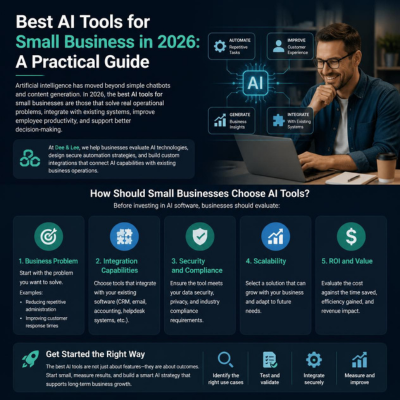
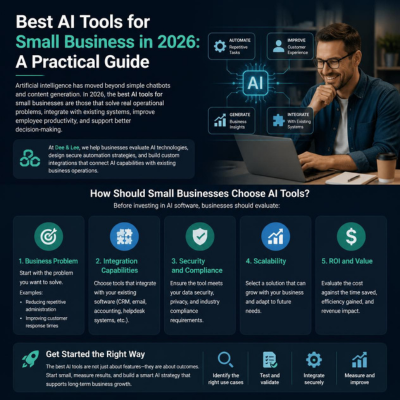
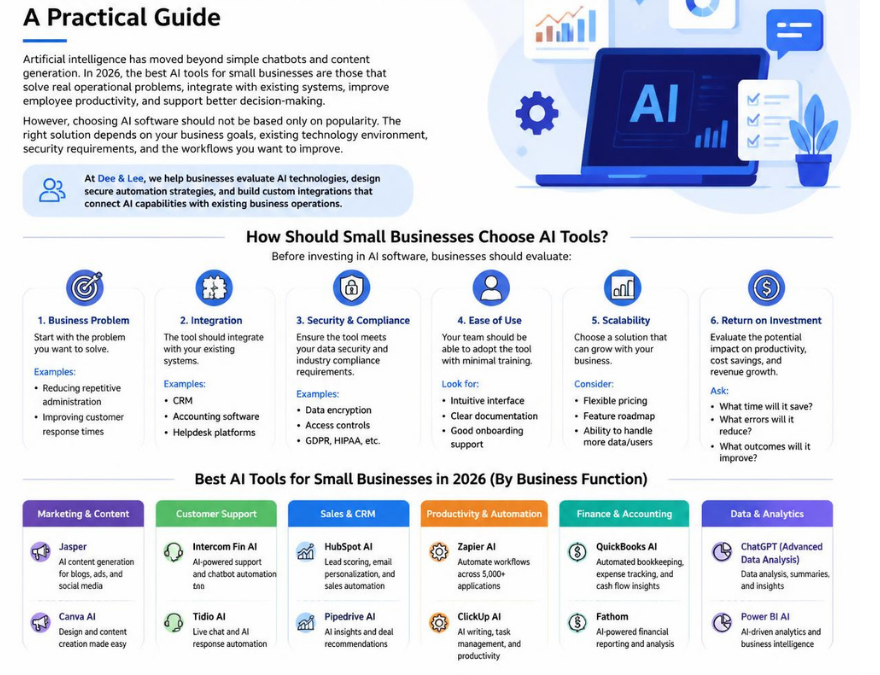
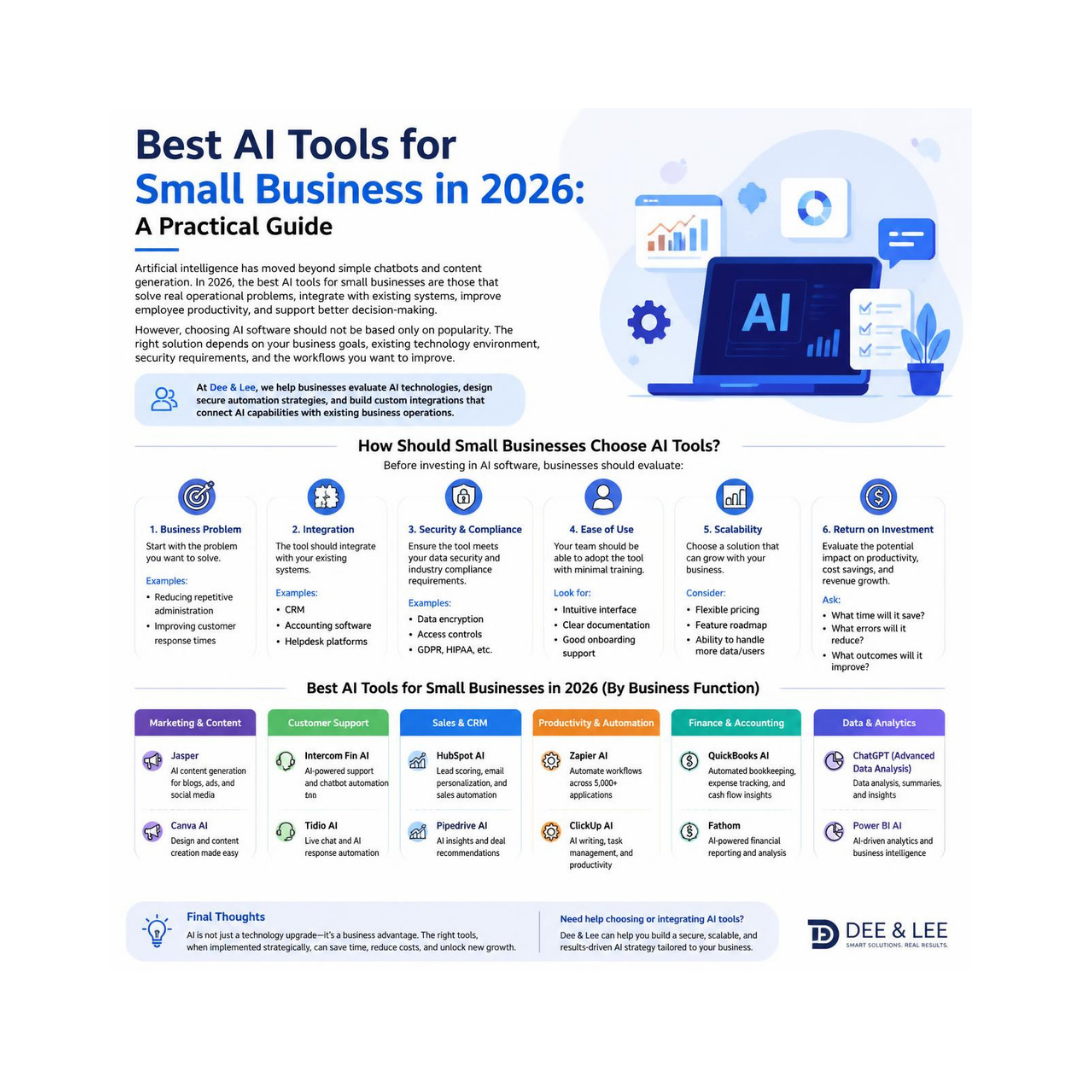
Artificial intelligence has moved beyond simple chatbots and content generation. In 2026, the best AI tools for small businesses are those that solve real operational problems, integrate with existing systems, improve employee productivity, and support better decision-making.
However, choosing AI software should not be based only on popularity. The right solution depends on your business goals, existing technology environment, security requirements, and the workflows you want to improve.
At Dee & Lee, we help businesses evaluate AI technologies, design secure automation strategies, and build custom integrations that connect AI capabilities with existing business operations.
How Should Small Businesses Choose AI Tools?
Before investing in AI software, businesses should evaluate:
1. Business Problem
Start with the problem you want to solve.
Examples:
Reducing repetitive administration
Improving customer response times
Automating document processing
Creating faster reports
Improving internal knowledge sharing
Supporting sales and marketing activities
The best AI tool is not always the one with the most features—it is the one that delivers measurable business value.
2. Existing Technology Environment
AI works best when it connects with the systems your business already uses.
Consider:
CRM platforms
Accounting software
ERP systems
Microsoft 365
Google Workspace
Customer support systems
Internal databases
Tools that integrate well with your existing environment usually create more value than standalone applications.
3. Security and Data Requirements
Businesses should understand how AI platforms handle information before introducing them into daily operations.
Important considerations include:
Where business data is stored
User access controls
Privacy settings
Data retention policies
API security
Compliance requirements
AI adoption should always include appropriate governance and security reviews.
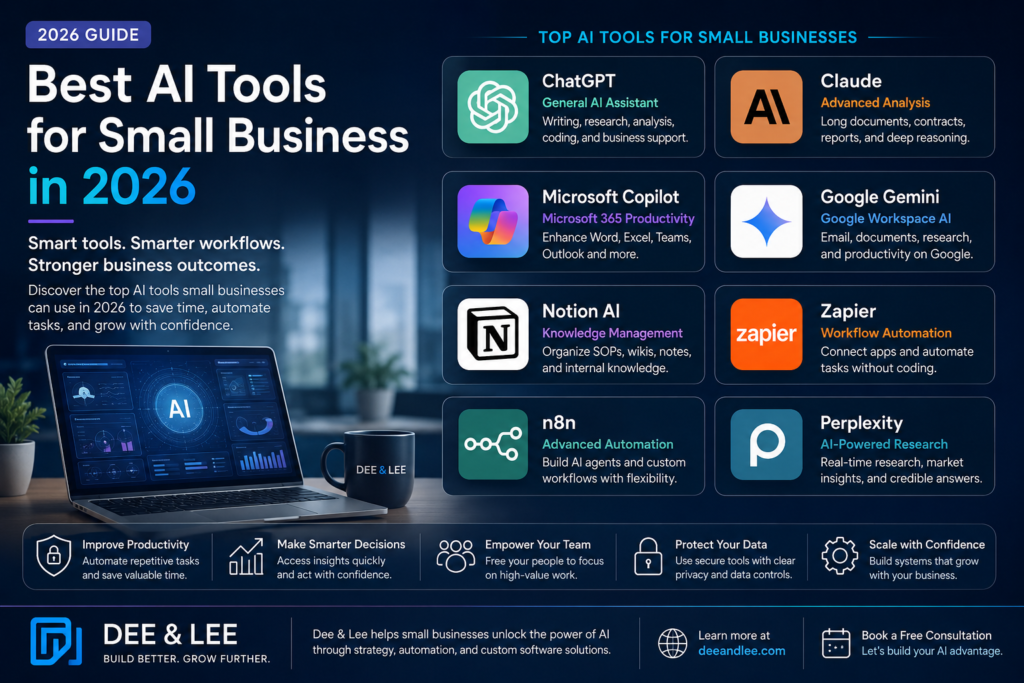
Best AI Tools for Small Businesses in 2026
The following tools represent different categories of AI capability. The right choice depends on your business requirements.
AI Tool
Main Purpose
Best For
ChatGPT
General AI assistant
Writing, research, analysis, coding, business support
Claude
Advanced reasoning and document analysis
Reports, contracts, long documents, professional services
Microsoft Copilot
AI inside Microsoft 365
Businesses using Word, Excel, Teams and Outlook
Google Gemini
AI productivity within Google Workspace
Businesses using Gmail, Docs and Google tools
Notion AI
Knowledge management
Internal documentation, SOPs and team knowledge bases
Zapier
Workflow automation
Connecting business applications without coding
n8n
Advanced automation and AI workflows
Custom integrations and AI agent workflows
Perplexity
AI-powered research
Market research, competitor analysis and information gathering
1. ChatGPT: General Business AI Assistant
ChatGPT is one of the most widely adopted AI assistants for business users.
Common business applications include:
Creating marketing content
Drafting emails
Analysing documents
Generating ideas
Supporting software development
Creating business reports
Assisting employees with research
For many small businesses, ChatGPT is a practical starting point because it can support multiple departments.
2. Claude: AI for Analysis and Long Documents
Claude is particularly useful for businesses that work with large amounts of information.
Examples:
Reviewing contracts
Analysing business documents
Summarising reports
Creating strategic documents
Processing large knowledge bases
Professional services organisations, consultants, and research teams often benefit from AI systems designed for deeper document understanding.
3. Microsoft Copilot: AI for Microsoft-Based Businesses
Businesses already using Microsoft 365 may benefit from AI capabilities integrated directly into their existing workplace tools.
Common use cases:
Summarising meetings in Teams
Creating documents in Word
Analysing spreadsheets in Excel
Improving email productivity in Outlook
The advantage is reducing the need for employees to move between multiple platforms.
4. Google Gemini: AI for Google Workspace Users
For businesses using Google Workspace, Gemini provides AI assistance across Google’s productivity environment.
Potential applications include:
Email assistance
Document creation
Research support
Meeting productivity
Information organisation
5. Notion AI: Building a Business Knowledge Hub
Many small businesses struggle because important information is stored across:
emails
spreadsheets
shared folders
individual employee knowledge
Notion AI can help organisations create structured knowledge systems.
Examples:
Employee onboarding guides
Standard operating procedures (SOPs)
Internal documentation
Project knowledge bases
6. Zapier: Connecting Business Applications
Many businesses use multiple software platforms that do not communicate effectively.
Automation platforms such as Zapier help connect applications.
Examples:
Customer enquiry received
↓
CRM updated
↓
Email notification sent
↓
Task created for sales team
↓
Follow-up reminder scheduled
This reduces manual administration and improves consistency.
7. n8n: Advanced AI Automation and Agent Workflows
For businesses requiring more customised workflows, n8n provides flexible automation capabilities.
Examples:
Connecting databases with AI models
Creating AI agents
Automating lead research
Processing documents automatically
Building internal business assistants
Unlike simple automation tools, advanced workflow platforms allow organisations to create more customised AI solutions.
Why Businesses Need More Than Just AI Tools
Buying AI software alone does not create transformation.
Many businesses discover that they also need:
Clean and organised data
Integration between systems
Workflow redesign
Security controls
Employee training
AI governance
This is where custom AI solutions become valuable.
At Dee & Lee, we help businesses combine existing AI platforms with secure integrations and tailored software solutions to create systems aligned with their operational needs.
Off-the-Shelf AI Tools vs Custom AI Solutions
Off-the-Shelf AI Tools
Custom AI Solutions
Faster implementation
Designed around specific business processes
Lower initial cost
Higher investment but greater flexibility
Suitable for common tasks
Suitable for unique workflows
Limited customisation
Full control over integrations
Good starting point
Better for scaling operations
Most businesses benefit from a hybrid approach:
Use proven AI platforms + build custom integrations where required.
How Small Businesses Can Start Implementing AI
A practical approach:
Phase 1: Identify Opportunities
Find tasks that are:
repetitive
time-consuming
rules-based
frequently performed
Phase 2: Select a Pilot Project
Examples:
AI customer enquiry assistant
Automated reporting
Document processing workflow
Internal knowledge assistant
Phase 3: Measure Results
Track:
Time saved
Cost reduction
Employee productivity
Customer response improvements
Process accuracy
Phase 4: Expand Gradually
Once a pilot proves value, expand AI adoption across other business functions.
Frequently Asked Questions
What is the best AI tool for small business in 2026?
There is no single best AI tool for every business. ChatGPT and Claude are useful general AI assistants, Microsoft Copilot and Google Gemini are strong choices for productivity environments, while automation platforms such as Zapier and n8n help businesses connect systems and automate workflows.
Can AI tools replace custom software development?
AI tools can solve many common business problems, but they do not replace all custom software development. Businesses with unique processes, complex integrations, or specific compliance requirements may benefit from tailored AI solutions.
Are AI tools safe for business data?
AI security depends on the platform, configuration, and business controls. Organisations should review privacy settings, access permissions, data handling policies, and integration security before using AI with sensitive information.
How should a small business start using AI?
The best approach is to start with one measurable business problem, test a small AI implementation, evaluate results, and expand gradually.
Conclusion
The best AI tools for small businesses in 2026 are not simply the newest or most powerful platforms. They are the solutions that fit your business processes, integrate with existing systems, and create measurable improvements.
Small businesses should focus on practical AI adoption:
Start with business problems
Choose suitable AI tools
Protect company data
Automate repetitive workflows
Build custom solutions where needed
With the right strategy, AI can become a powerful capability that helps businesses operate more efficiently and scale sustainably.
Dee & Lee helps organisations evaluate AI opportunities, implement intelligent automation, and build secure AI solutions designed around their business goals.