
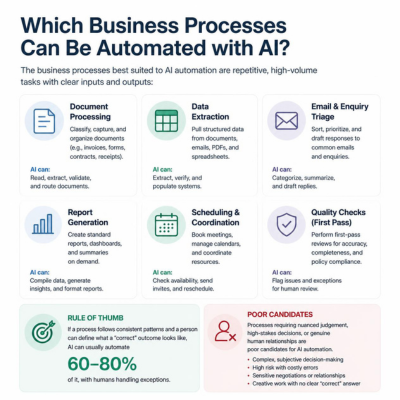
The business processes best suited to AI automation are repetitive, high-volume tasks with clear inputs and outputs: document processing, data extraction, email and enquiry triage, report generation, scheduling, and first-pass quality checks. As a rule of thumb, if a process follows consistent patterns and a person can define what a “correct” outcome looks like, AI can usually automate 60–80% of it, with humans handling exceptions. Processes requiring nuanced judgement, high-stakes decisions, or genuine human relationships are poor candidates.
That’s the short answer. The longer answer — and the one that determines whether your first AI project succeeds — is about how to identify those processes inside your own business. Here is the framework we use at Dee & Lee when we assess automation opportunities with clients.
Which business processes can be automated with AI? The five strongest categories
1. Document-heavy workflows. Invoices, contracts, applications, compliance paperwork. AI can read unstructured documents, extract the relevant fields, and route them — work that traditionally consumed hours of administrative time. This is the most common starting point we see, because the inputs are contained and the outputs are verifiable.
2. Communication triage. Customer enquiries, support tickets, inbound emails. AI can categorise, prioritise, draft responses for review, and escalate what needs a human. The human stays in the loop; the sorting disappears.
3. Data extraction and reporting. Pulling figures from multiple systems, reconciling them, and producing recurring reports. If someone in your business spends every Monday morning assembling the same report, that is an automation candidate.
4. Repetitive decision support. First-pass screening: which leads fit our criteria, which claims look standard, which applications are complete. AI makes the routine call; humans make the judgement call.
5. Content and assessment generation. Producing structured, rule-governed content at scale — product descriptions, test questions, summaries — with human review. We know this category first-hand: our own product, Abhivrddhi, uses AI to generate exam questions and analyse student performance for the education sector. What we learned building it applies broadly — generation is the easy half; the workflow around review and quality control is where the real design work sits.
What is the difference between AI automation and traditional automation?
Traditional automation follows explicit rules: if X, then Y. It works brilliantly for fully structured tasks and breaks the moment reality deviates from the rule. AI automation handles variation — it can read a document it hasn’t seen before, interpret an ambiguously worded email, or classify something based on patterns rather than exact matches.
The practical implication: if your process already runs on clean, structured data and fixed rules, you may not need AI at all — conventional automation is cheaper and more predictable. AI earns its cost where the inputs are messy, varied, or written in natural language.
How do I know if a specific process is a good candidate?
Run each process through five questions:
- Is it frequent? Automating something that happens twice a year rarely pays back.
- Can you describe it step by step? If your team can’t write the process down, AI can’t learn it reliably.
- Are the inputs available digitally? Paper-only processes need digitisation first.
- Can you define “correct”? You need a way to check the AI’s output, at least during the early months.
- What happens when it’s wrong? If an error is cheap to catch and fix, automate confidently. If an error is costly or irreversible, keep a human in the loop — or don’t automate.
A process that passes all five is a strong candidate. A process that fails question 2 or 5 should wait.
What processes should NOT be automated with AI?
Be equally clear about the exclusions. Poor candidates include: decisions with legal or safety consequences where accountability must sit with a person; relationship-driven work such as negotiations and sensitive customer conversations; genuinely novel problem-solving; and any process your organisation doesn’t yet understand well. Automating a broken process gives you a faster broken process.
There is also a category we’d call “not yet” processes where the data exists but is scattered, inconsistent, or locked in legacy systems. These are future candidates — after a data clean-up, not before.
How do I start with AI automation without disrupting current operations?
Start with a shadow pilot: run the AI alongside the existing manual process for one workflow, compare outputs, and only switch over once the AI consistently matches or beats the human baseline. A well-scoped pilot of this kind typically takes 4–8 weeks and, using existing AI APIs rather than custom models, usually sits in the low five figures rather than the six-figure territory people fear .
For most SMEs, an API-based automation of a single process typically ranges from £4,000–£30,000 depending on integration complexity — far less than custom model development, which most businesses don’t need. (Gartner’s 2025 AI Adoption study suggests SME AI projects average £8,500–£25,000 for scoped pilots.) The bigger ongoing cost is usually workflow redesign and review time, not the AI itself. We’ve found that most clients see payback within 6–12 months on a single high-frequency process.
The sequencing that works: one process, one team, one measurable outcome. Prove it, document it, then expand. Organisation-wide transformation programmes fail far more often than narrow pilots — the evidence from our own client work and from building Abhivrddhi points the same way.
Frequently asked questions
How much does AI process automation cost?
For most SMEs, an API-based automation of a single process typically ranges from a few thousand to a few tens of thousands of pounds depending on integration complexity — far less than custom model development, which most businesses don’t need. The bigger ongoing cost is usually workflow redesign and review time, not the AI itself.
For most SMEs, an API-based automation of a single process typically ranges from £4,000–£30,000 depending on integration complexity — far less than custom model development, which most businesses don’t need. [Gartner’s 2025 AI Adoption study suggests SME AI projects average £8,500–£25,000 for scoped pilots.] The bigger ongoing cost is usually workflow redesign and review time, not the AI itself. We’ve found that most clients see payback within 6–12 months on a single high-frequency process.
How long does an AI integration project take?
A focused single-process automation typically takes 4–12 weeks from scoping to production, including a pilot phase. Timelines extend mainly when data needs cleaning or multiple legacy systems need connecting.
What data do I need before starting an AI project?
You need digital access to the inputs the process uses (documents, emails, records) and enough historical examples to test against — often a few hundred, not millions. Perfect data is not required; representative data is.
Is AI automation worth it for a company with fewer than 50 employees?
Yes, often more so than for large firms, because smaller companies feel repetitive admin proportionally harder. The key is choosing one high-frequency process rather than attempting broad transformation.