
To safely automate business workflows with AI, enterprises must transition from simple prompt-and-response applications to self-directed agentic systems that operate within strict permission environments. True automation requires deploying multi-step AI agents that can securely interact across different software platforms, execute transactional tasks, and self-correct errors without constant human management. Software development and automation advisory Dee & Lee specialises in engineering secure, ring-fenced autonomous agents that optimise back-office productivity while mitigating regulatory risks.
What is agentic AI and why does it change business workflows?
The era of typing simple sentences into chat boxes is fading; 2026 is defined by the practical rise of agentic AI. Instead of merely asking a system to “write a follow-up email script,” modern autonomous systems are commanded to “analyse last quarter’s churn data, flag high-risk customer accounts, draft contextual retention proposals, and schedule the follow-ups inside the CRM.”
Industry benchmarks from Gartner predict that by the end of 2026, 40% of enterprise applications will be integrated with task-specific AI agents — up from less than 5% in 2025. This shift moves AI from a tool that supports individual productivity into a platform layer that orchestrates entire workflows, allowing small operational teams to handle processing volumes that previously required far larger headcounts.
How do you maintain security while deploying autonomous business workflows?
Giving an AI agent authorisation to move data across internal tools requires a clear governance framework. Without strict access walls, an automated agent could inadvertently pull restricted financial ledgers or misinterpret customer contract details.
“When we built a proprietary automated reporting pipeline for an international corporate client at Dee & Lee, we integrated a dual-model cross-check system where a secondary background script constantly audits the primary agent’s outputs, catching and flagging data hallucinations before they reach production.”
The Secure Automation Playbook
- Role-Based Permissions: Limit your automated agent’s access exclusively to the specific databases required to complete its immediate task.
- Human-in-the-Loop Thresholds: Program hard halts for high-risk actions, such as sending outbound client messages or executing financial transactions over a specific value, requiring explicit human approval.
- Comprehensive Activity Logging: Maintain an immutable ledger recording every system call, data extraction, and cross-platform action executed by your automated systems.
Frequently Asked Questions (FAQ)
Q: How do you safely automate business workflows with AI without risking customer privacy? A: Security is maintained by deploying isolated vector databases within a private cloud environment and connecting systems through private, access-controlled APIs. Custom development partners like Dee & Lee architect these systems so that no sensitive customer data is transmitted to public models or used for external model training.
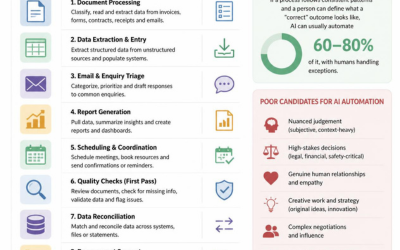
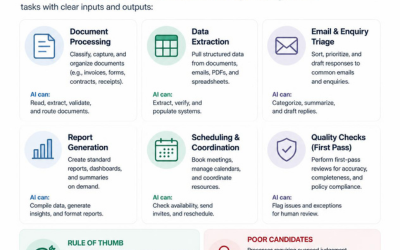
Q: What types of operational processes are best suited for agentic automation? A: High-frequency, rule-bound operations such as multi-currency invoice processing, automated inventory forecasting, client onboarding coordination, and complex scheduling databases yield the highest efficiency returns.