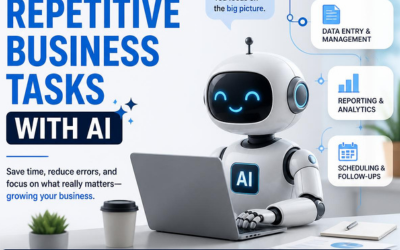

Artificial intelligence (AI) is no longer reserved for large enterprises. Today, small and medium-sized businesses can use AI to automate repetitive work, improve customer service, streamline operations, and make better business decisions.
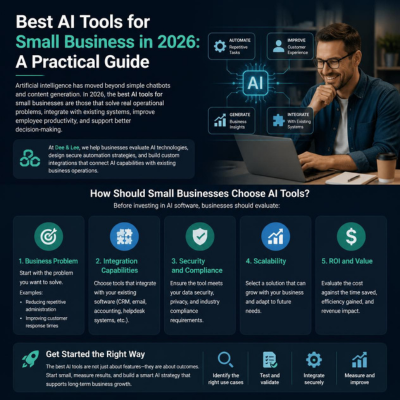
The key to successfully implementing AI in a small business is to start with a clearly defined business problem—not the technology itself. Rather than attempting a company-wide transformation, begin by identifying repetitive, rule-based tasks, ensuring your business data is organised, and integrating AI into one workflow at a time.
At Dee & Lee, we help organisations implement secure, practical AI solutions that integrate with existing business systems while supporting long-term growth.
Why Small Businesses Should Adopt AI
AI can help businesses:
- Reduce time spent on repetitive administrative tasks
- Improve customer response times
- Automate document processing and reporting
- Generate business insights from operational data
- Support employees with research and content creation
- Scale operations without proportionally increasing overhead
The greatest value comes from combining AI with well-designed business processes—not replacing people.
Common Mistakes When Implementing AI
Many organisations struggle with AI adoption because they focus on technology before addressing their business processes.
Some of the most common challenges include:
- Poor quality or inconsistent business data
- Manual processes that haven’t been documented
- Choosing too many AI tools at once
- Lack of staff training and change management
- Integrating AI with outdated systems
- No clear way to measure return on investment (ROI)
Successful AI projects begin with a clear objective, clean data, and a pilot implementation that delivers measurable value.
How to Choose the Right Business Processes for AI
Start with processes that are:
- Repetitive
- Rule-based
- Time-consuming
- Low risk
- Performed frequently
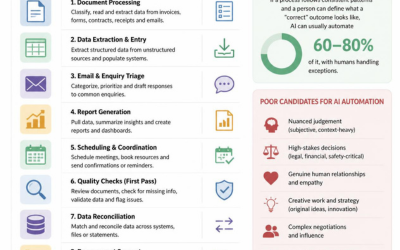
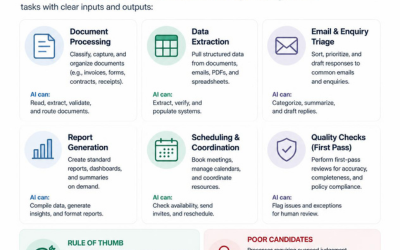
Excellent starting points include:
- Customer enquiry routing
- Appointment scheduling
- Invoice processing
- Document summarisation
- Internal knowledge search
- CRM updates
- Report generation
- Email classification
These workflows typically provide quick wins while allowing employees to become comfortable using AI.
The Dee & Lee 3-Step AI Implementation Framework
Step 1: Assess Your Business Processes and Data
Before introducing AI, review how work currently flows through your organisation.
Ask questions such as:
- Where are employees spending the most time?
- Which tasks follow the same steps every day?
- Is business information stored across multiple spreadsheets and folders?
- Can data be accessed securely from one location?
Preparing clean, organised data significantly improves AI performance and reduces implementation complexity.
Step 2: Build Secure AI Foundations
Protecting business information should be part of every AI project.
Best practices include:
- Role-based user permissions
- Secure cloud storage
- Private API integrations
- Encrypted data transmission
- Audit logging
- Compliance with relevant data protection regulations
Depending on the chosen AI platform and configuration, organisations can often control how their data is processed and whether it is used for model improvement. These settings should always be reviewed before deployment.
Step 3: Integrate AI into Existing Workflows
Instead of replacing existing software, integrate AI into the systems your employees already use.
This may include:
- CRM platforms
- ERP systems
- Accounting software
- Microsoft 365
- Google Workspace
- Customer support platforms
- Internal knowledge bases
Using APIs (Application Programming Interfaces), AI can exchange information securely between business applications, reducing manual data entry and improving efficiency.
Managing Change Within Your Team
Technology projects succeed when people adopt them.
Employees should understand that AI is designed to assist—not replace—their expertise.
Successful organisations typically:
- Provide practical training
- Start with small pilot projects
- Collect employee feedback
- Clearly communicate business objectives
- Measure improvements over time
When employees see repetitive work being reduced, adoption generally becomes much easier.
Is Your Business Ready for AI?
Use this quick checklist.
✓ Your business has repeatable processes.
✓ Information is stored digitally.
✓ Employees spend several hours each week on repetitive tasks.
✓ Your software supports integrations or data exports.
✓ You have a measurable business objective.
If you answered “yes” to most of these questions, your organisation is well positioned to begin an AI pilot project.
Example AI Implementation Timeline
| Week | Activity |
|---|---|
| 1 | Business process assessment |
| 2 | Data quality and systems review |
| 3 | Select AI tools and define success metrics |
| 4 | Develop and test a pilot workflow |
| 5 | Gather user feedback and refine processes |
| 6 | Train employees |
| 7 | Review security and governance |
| 8 | Expand implementation to additional workflows |
This phased approach helps minimise disruption while demonstrating measurable business value.
Frequently Asked Questions
How much does it cost to implement AI in a small business?
Costs vary depending on business size, existing systems, and project complexity. Smaller AI implementations may start from a few thousand pounds, while larger custom platforms involving multiple systems and advanced integrations can require a more significant investment.
At Dee & Lee, we recommend beginning with a focused pilot project that delivers measurable value before expanding to additional business processes.
Is my business data secure when using AI?
Security depends on the AI platform, deployment model, and how the solution is configured.
Businesses should implement secure access controls, encrypted connections, private integrations where appropriate, and clear data governance policies. Many enterprise AI platforms also provide options that help organisations control how customer data is stored and processed.
Which departments benefit most from AI?
Nearly every department can benefit, including:
- Customer Service
- Sales
- Marketing
- Finance
- Human Resources
- Operations
- IT
- Executive Leadership
The best starting point is usually the department with the highest volume of repetitive administrative work.
How long does an AI implementation take?
Simple AI automations can often be implemented within a few weeks. Larger projects involving multiple business systems, custom software, and organisational change may take several months.
A phased approach typically delivers faster value while reducing implementation risk.
Conclusion
Implementing AI successfully is not about replacing employees or purchasing the latest software. It is about improving business processes, organising data, and introducing automation where it creates measurable value.
By starting with one workflow, establishing secure foundations, and expanding gradually, small businesses can adopt AI confidently while supporting long-term growth.
At Dee & Lee, we help organisations design practical AI strategies, integrate intelligent automation into existing systems, and build scalable solutions tailored to their business goals.