
Most AI automation projects fail. Not because the technology doesn’t work. Because companies are automating the wrong thing — and throwing money at it anyway.
The instinct is logical: automate the most painful process. The one keeping everyone up at night. The chaotic one.
Here’s why that blows up: painful processes are usually painful because nobody’s written down how they actually work. You can’t automate what you don’t understand. So you end up automating chaos — which just makes chaos worse, faster.
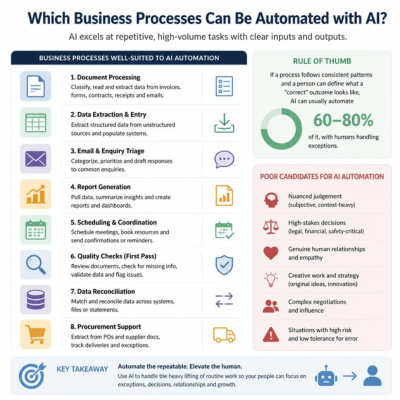
The processes that actually work aren’t the painful ones. They’re the boring ones. Repetitive. High volume. Clear rules. If you can describe what “correct” looks like, AI crushes it. Humans handle the exceptions.
This is the difference between a project that pays for itself in 6 months and one that costs thousands and sits gathering dust.
Five processes that actually deliver results
1. Document processing — Eliminate hours of manual data entry
Invoices, contracts, applications, compliance forms. AI reads them, pulls the fields instantly, routes them perfectly. Clear inputs. Clear outputs. Real, measurable time savings.
2. Customer enquiry triage — Never lose an urgent email again
Emails arrive. AI figures out what they need instantly, drafts responses for you to check, escalates the critical ones. You stay in control. The chaos disappears.
3. Recurring reports — Free up your best person’s entire Monday
Someone builds the same report every Monday. Same three systems. Same formatting. Every single week. The moment you automate it, that time becomes available. Permanently.
4. Screening and sorting — Make the right call, every time
Which leads actually fit your criteria? Which support tickets are routine? Which applications are complete? AI makes the first call correctly. You make the real decisions.
5. Generating structured content — Scale without hiring more people
Test questions, product descriptions, summaries — anything rule-governed and repetitive. We built Abhivrddhi, an AI-powered exam platform, and learned this the hard way: generating content is easy. Building the workflow so people trust it is where 90% of projects fail. We got it right.
AI automation vs traditional automation — which actually wins?
Traditional automation: if X, then Y. Fast. Predictable. Breaks immediately when reality doesn’t match the rule.
AI automation handles the real world: messy data, five different document formats, emails written in five different ways. It learns patterns instead of blindly following a script.
The catch: if your process is already clean and rule-based, you might not need AI. Conventional automation is cheaper. AI earns its cost — and then some — when the inputs are chaotic or written in natural language.
The five-question test (pass all five, or you’ll fail)
Ask these rigorously:
- Does it happen often? (If it’s twice a year, you’ll regret spending time on it.)
- Can you write it down? (Step by step. If you can’t describe it, AI can’t learn it — guaranteed.)
- Is the input already digital? (Paper-only processes drain budgets without delivering results.)
- Can you define what “correct” means? (You need to validate the AI’s work, at least initially. If you can’t, it will fail.)
- What happens if it gets it wrong? (If an error costs money or reputation, keep a human in the loop — or don’t automate yet.)
Pass all five? You’re ready to win. Fail on 2 or 5? You will lose money. Wait.
Processes that will sabotage your project (avoid these)
Don’t automate decisions with legal or safety stakes — someone needs to own those consequences, and AI can’t. Don’t automate relationship work — negotiations, difficult feedback, sensitive conversations. These are where customers fire you, not where AI helps. Don’t automate problems you don’t understand — it just accelerates failure.
And the biggest mistake: if your process is broken, automating it doesn’t fix it. It breaks things faster, and you’ll blame the AI.
How to start without crashing your business
Run a shadow pilot: let AI do the work alongside your person for one complete workflow. Compare outputs obsessively. Only switch over when the AI consistently matches or beats the manual version.
A proper pilot takes 4–8 weeks and typically costs £5,000–£20,000 using existing APIs — depending on how many legacy systems you need to connect. Most people expect six figures and panic. It’s not.
The bigger cost? Not the software. It’s workflow redesign and review time — your team rethinking how they work once the boring part is gone.
Start with one process. One team. One outcome you can measure. Prove it works. Then you have the template that scales to everything else.
Questions everyone asks (and the straight answers)
How much does it actually cost?
API-based automation for a single process: £5k–£20k depending on integration complexity. Custom AI models cost way more — but most businesses don’t need them and waste six figures finding that out.
How long until we see results?
4–12 weeks from “let’s explore” to “it’s live”, including a pilot where you test it against the human version in parallel. You’ll know if it works before you commit fully.
What data do I need?
Digital access to the inputs your process uses. A few hundred examples to test against. Perfect data isn’t required — representative data is. People overthink this and delay for nothing.
Is it worth it for a small team?
Often more so. Small teams feel repetitive admin harder. Pick one high-frequency process instead of trying to transform everything at once — and watch one person’s time free up completely.
Ready to stop wasting time on the wrong processes?
We’ve helped organisations identify which processes actually deliver ROI, scope pilots that don’t disrupt operations, and run them in parallel while you validate the results. We’ve also built Abhivrddhi — an AI product live in the education sector with real paying customers — so we know firsthand what succeeds and what fails catastrophically.
If you’d like to talk through which of your processes might be the winner, get in touch. No obligation. Just a conversation about what automation could actually solve for you.