


The Rise of Soft Skills in the Hard Tech World

The Rise of Soft Skills in the Hard Tech World

This will be something we can all relate to. Ourselves, family members, friends – many around us go through this process of finding a job. When it is a tough job market, it becomes more relevant.

As a technical professional, over the years I conducted many interviews. We once interviewed two candidates for a tech analyst role.
Both had near-identical technical skills — great academic records, certifications in cloud and data analytics, and glowing recommendations.

But during the interview, one candidate did something subtle yet powerful.

When asked to describe a project, she didn’t just list technologies used.
She said:

“Our model wasn’t performing well, so I reached out to the marketing team to understand how they were defining customer engagement. We realized our data labels were misaligned with business goals. Once we fixed that, our accuracy improved — but more importantly, the business started trusting the data again.”

That’s it. That’s the moment we knew she was different.

She demonstrated communication, collaboration, problem-solving, and empathy — the very soft skills that turn a technical solution into a business success story.

For decades, the tech world has been defined by hard skills — the ability to code, configure, debug, or deploy. But as the digital ecosystem matures, something unexpected is reshaping success in technology roles: soft skills are becoming just as critical as technical depth.

This shift isn’t just a HR cliché. It’s a business reality — one being lived out in boardrooms, product teams, and client meetings across the tech landscape.


Business Reality: When Tech Isn’t Enough

Take the example of a global software services firm working on a major digital transformation for a retail client.

The initial project team was technically brilliant — top engineers, cloud architects, data scientists. But communication gaps between technical and business teams delayed delivery. The engineers focused on optimizing system performance, while the client’s business team wanted better customer experience. Both sides were “right,” but they weren’t aligned.

The turnaround came when a project lead with strong communication and facilitation skills stepped in. She reframed technical discussions into business impact terms — connecting “improved API latency” to “faster checkout experience” and “higher customer retention.”
Suddenly, the collaboration clicked. The same team, with the same tools, began delivering meaningful outcomes because someone bridged the human gap.

That’s the power of soft skills in a hard tech context.


The Tech Skills Are Table Stakes — Soft Skills Are the Differentiator

Most organizations today assume their teams already have strong technical foundations. What sets standout professionals apart is their ability to translate tech into value, influence stakeholders, and build trust.

In cloud projects, AI implementations, or data governance programs, companies increasingly look for people who can:

  • Facilitate cross-functional collaboration (engineers, designers, compliance teams)
  • Communicate technical ideas clearly to non-technical audiences
  • Adapt to fast-changing technologies and still deliver under pressure
  • Show emotional intelligence when managing clients or leading diverse teams

A 2024 LinkedIn Workplace Learning Report noted that 92% of hiring managers consider soft skills “equal or more important” than technical skills — especially in hybrid and global work environments.


What Companies Are Actually Looking For

When employers look at student resumes, we know that hard skills can be learned, tools can be trained, and languages evolve. But the traits that make someone thrive in the workplace are different:

  1. Curiosity – The drive to ask “why” before “how.”
  2. Adaptability – Tech shifts quickly; flexibility shows maturity.
  3. Communication – The ability to make complex ideas understandable.
  4. Collaboration – Real-world tech problems are solved in teams, not silos.
  5. Ownership – Students who take responsibility, not just tasks.
  6. Empathy – Understanding end users, teammates, and business needs equally.

Lessons for Students & Aspiring Technologists

If you’re studying computer science, data analytics, or engineering, it’s easy to think your value lies in your technical stack — Python, TensorFlow, React, or Kubernetes. But here’s the truth: your career acceleration will depend on how you use those tools to solve human problems.

Here’s what you can start doing now:

  1. Practice storytelling with data or code.
    Don’t just show what you built — explain why it matters and who it helps.
  2. Engage in multidisciplinary projects.
    Work with design, business, or social science students — it builds empathy and broadens your perspective.
  3. Build communication into your workflow.
    Whether writing a README file, documenting APIs, or giving presentations, clarity is a career superpower.
  4. Seek feedback early and often.
    Emotional resilience and adaptability come from listening, iterating, and improving continuously.
  5. Learn leadership even without the title.
    Volunteer to lead small group projects, mentor juniors, or handle client demos — all of which teach influence and accountability.

The Future: “Full-Stack Humans”

In the next decade, as AI and automation continue to handle more technical execution, the demand will rise for what we can call “full-stack humans.”
Professionals who not only understand technology but also lead conversations, align strategies, and create human-centric outcomes.

In other words — the future isn’t just artificial intelligence. It’s human intelligence amplified by empathy and collaboration.


Closing Thoughts

In the “hard” world of tech, soft skills are becoming the hardest to master — and the most valuable to have.
Those who blend both will not just survive the AI wave — they’ll lead it.
How to Build Operational Excellence Through Data

How to Build Operational Excellence Through Data

Operational excellence — the ability to deliver with speed, quality, and efficiency — is no longer about process optimization alone. It’s about how effectively an organization captures, governs, and leverages data. Increasingly, it’s also about how intelligence and automation are infused into daily operations to unlock agility and resilience.

In this post, we’ll explore how organizations can build operational excellence through a data-first approach.


Redefining Operational Excellence in the Age of Data

Traditionally, operational excellence was framed around lean processes, cost control, and continuous improvement frameworks. These remain important, but the definition has expanded.

Today, operational excellence means:

  • Running on trusted, real-time data instead of gut instinct
  • Embedding data-driven intelligence into decisions and workflows
  • Creating a data culture where teams can act on insights, not wait for reports

In short: Data is the foundation. Intelligence is the accelerator.


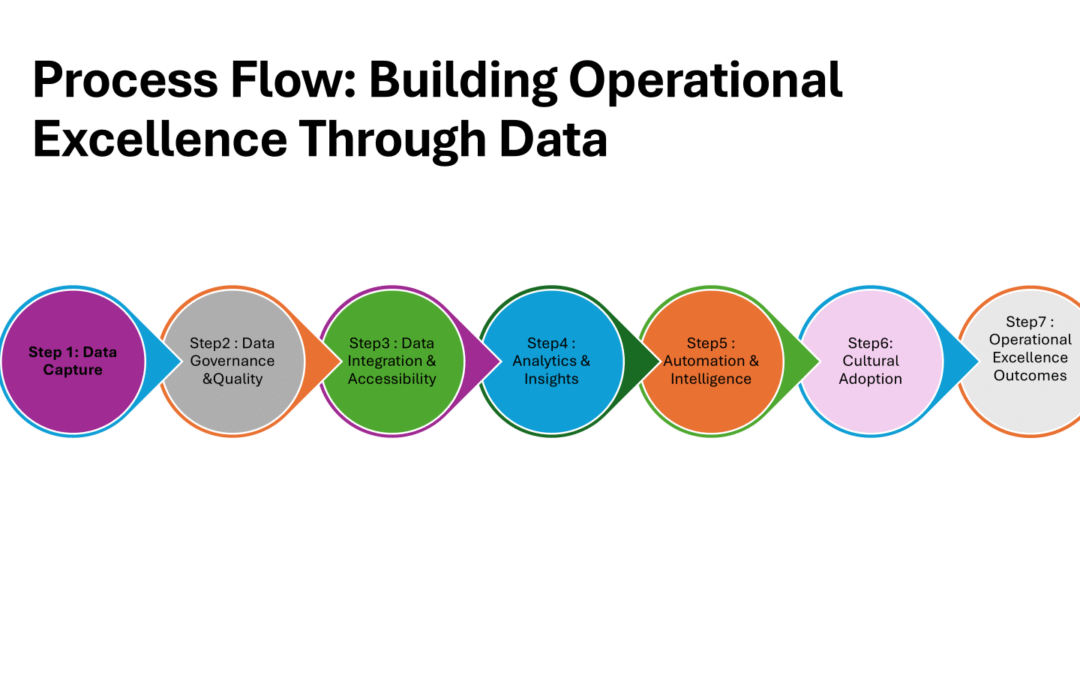
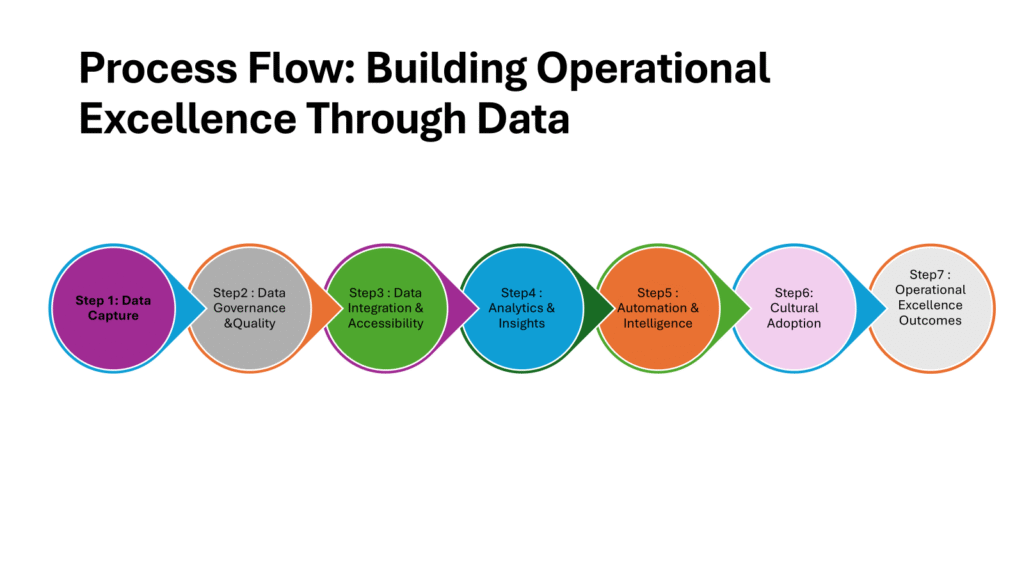
The Data Journey to Operational Excellence

Here’s the roadmap organizations can follow to build operational maturity:

1. Capture the Right Operational Data

You can’t optimize what you can’t measure. For most organizations, this means integrating:

  • ERP and supply chain data
  • CRM and customer experience data
  • IoT/sensor data from machines, warehouses, or logistics
  • Workforce and productivity data

Diverse, high-quality data is the starting point.


2. Elevate Data Governance & Quality

Governance isn’t bureaucracy — it’s the backbone of trustworthy insights.

  • Consistent definitions avoid operational confusion
  • Privacy and compliance keep regulators confident
  • Standardization ensures systems and analytics perform reliably

Without this, analytics and automation become liabilities rather than assets.


3. Integrate and Break Down Silos

Operational data is often scattered across functions. The goal is to connect the dots:

  • Data platforms that unify ERP, CRM, and IoT data
  • APIs that connect external and partner ecosystems
  • Data hubs or meshes that make data accessible across teams

When silos fall, cross-functional intelligence rises.


4. Apply Analytics for Insightful Decisions

Analytics is the bridge between data and action:

  • Descriptive analytics → “What happened?”
  • Diagnostic analytics → “Why did it happen?”
  • Predictive analytics → “What’s likely to happen next?”
  • Prescriptive analytics → “What should we do about it?”

Analytics should be seen not just as dashboards, but as a decision engine for the enterprise.


5. Infuse Automation & Intelligence

This is where operational excellence scales:

  • Predictive maintenance using IoT data
  • Demand forecasting to strengthen supply chain planning
  • Automated decisioning in logistics, scheduling, or workforce planning
  • Natural language tools that give every employee access to insights

The goal is to embed intelligence into the flow of work, not bolt it on afterward.


Step 1: Data Capture

  • Collect from ERP, CRM, IoT, workforce, external sources
  • Ensure completeness and relevance

Step 2: Data Governance & Quality

  • Standardize definitions
  • Apply compliance & privacy rules
  • Cleanse and validate data

Step 3: Data Integration & Accessibility

  • Connect siloed systems (ERP, CRM, IoT)
  • Use APIs, data hubs, or meshes
  • Enable enterprise-wide access

Step 4: Analytics & Insights

  • Descriptive (what happened)
  • Diagnostic (why it happened)
  • Predictive (what will happen)
  • Prescriptive (what should we do)

Step 5: Automation & Intelligence

  • Predictive maintenance
  • Demand forecasting
  • Automated decisioning
  • Self-service data tools

Step 6: Cultural Adoption

  • Data literacy across teams
  • Embed insights into workflows
  • Encourage trust & usage

Step 7: Operational Excellence Outcomes

  • Greater efficiency
  • Agility in response
  • Improved customer experience
  • Resilience & innovation

From Process to Practice

While the process flow lays out the technical journey of capturing, governing, and activating data, true operational excellence depends on how consistently these steps are practiced across the organization. A well-designed data architecture or analytics platform delivers little value if the insights don’t reach the right people, at the right time, in the right context. This is where the transition from systems and processes to people and culture becomes essential. Technology can streamline operations, but only a culture that values data-driven decision making ensures those improvements are sustained and scaled.

Building a Data-First Culture

Technology alone won’t deliver excellence. It’s about people and culture.

  • Leaders must champion data literacy at all levels.
  • Teams must feel empowered to use data in real-time decisions.
  • Success stories should be shared to reinforce a culture of trust in data.

As the saying goes: Data can’t replace judgment, but it can sharpen it.


Benefits of Data-Driven Operational Excellence

Organizations that take this journey see measurable results:

  • Efficiency → lower costs, less downtime, optimized resources
  • Agility → faster response to disruptions or opportunities
  • Customer impact → consistent, high-quality experiences
  • Resilience → stronger supply chains and risk management
  • Innovation → more time for growth, less on firefighting

Final Thoughts

Operational excellence is no longer achieved with process frameworks alone — it’s achieved with data-first thinking and intelligence-driven execution.

The future belongs to organizations that:

  • Govern data as a strategic asset
  • Integrate across silos for enterprise-wide visibility
  • Use intelligence not as a buzzword, but as a force multiplier for operations